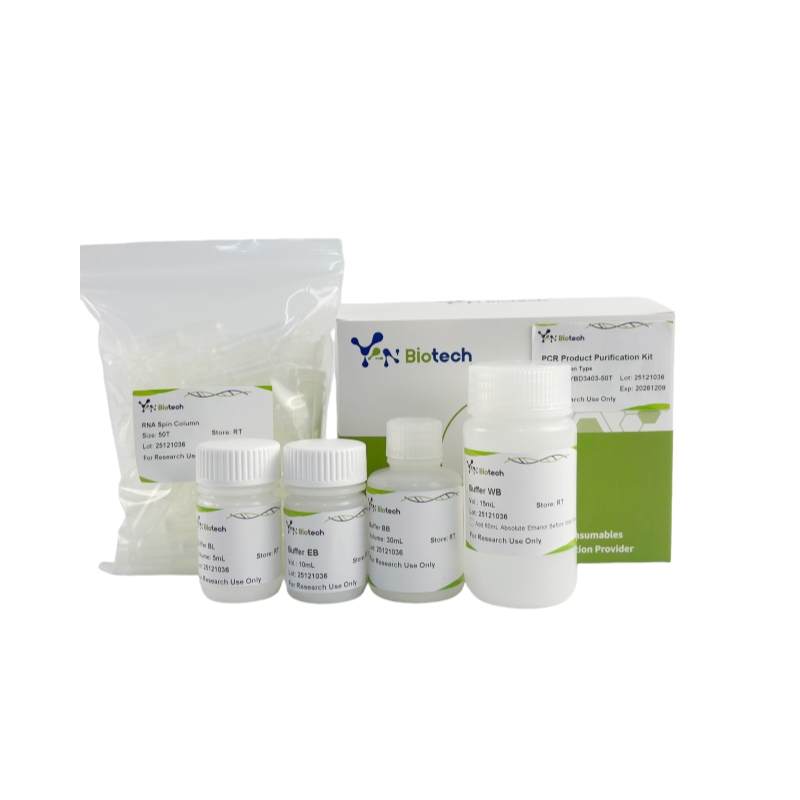
Suitable for the purification and recovery of PCR reaction products, enzymatically digested DNA fragments, probe labeling products, as well as the concentration of DNA samples, among other applications.
Cat. No. :
YBP3403-50TBrand :
YanbiotechProduct Origin :
ChinaVolume :
50TProduct Introduction
In the presence of a high-concentration chaotropic salt, DNA fragments selectively bind to the silica-based membrane in the spin column. Through a series of rapid washing and centrifugation steps, impurities such as primers, nucleotides, proteins, and enzymes are removed by the wash buffer. Finally, a low-salt, high-pH elution buffer is used to elute the purified DNA from the silica membrane.
I. Product Information:
| Contents | Storage | 50T | 100T | 200T |
| Buffer BL | RT | 5mL | 10mL | 2×10mL |
| Buffer BB | RT | 30mL | 60mL | 100mL |
| Buffer WB | RT | 15mL | 25mL | 2×25mL |
| Add the specified amount of ethanol according to the instructions before use | ||||
| Buffer EB | RT | 10mL | 15mL | 20mL |
| Spin EC | RT | 50pcs | 100pcs | 2×100pcs |
| Collection Tube (2mL) | RT | 50pcs | 100pcs | 2×100pcs |
II. Storage Condition:
1. This kit can be stored for 12 months under dry conditions at room temperature (15°C–25°C).
2. All solutions should be clear. If precipitation occurs due to low temperature, the solutions should not be used directly. Warming in a 37°C water bath for several minutes will restore clarity. Before use, allow the solutions to return to room temperature.
3. Storage at low temperatures (4°C or –20°C) may cause precipitation and affect performance; therefore, transport and storage should be carried out at room temperature (15°C–25°C).
4. To prevent evaporation, oxidation, or pH changes due to prolonged exposure to air, tightly cap all solution containers immediately after use.
III. Materials to Be Prepared by the User:
Absolute ethanol, benchtop high-speed centrifuge, constant-temperature water bath, pipettes, electrophoresis tank, gel imaging system, etc.; DNA Marker, loading dye, agarose, electrophoresis buffer (1× TAE or 0.5× TBE), 1.5 mL centrifuge tubes, etc.
IV. Product Description:
In the presence of a high-concentration chaotropic salt, DNA fragments selectively bind to the silica-based membrane in the spin column. Through a series of rapid washing and centrifugation steps, impurities such as primers, nucleotides, proteins, and enzymes are removed by the wash buffer. Finally, a low-salt, high-pH elution buffer is used to elute the purified DNA from the silica membrane.
V. Product Feature:
1. All silica membranes in the spin columns are made from high-quality, specially engineered adsorption material, ensuring minimal variation in binding capacity between columns.
2. The high-quality lysis buffer contains no sodium iodide or perchlorate commonly found in traditional formulations, thus avoiding inhibition of downstream enzymatic reactions such as digestion, ligation, and cloning after recovery.
3. The lysis buffer Buffer is tinted with phenol red, providing a yellow color that facilitates visual monitoring of lysis progress and pH changes, thereby optimizing binding conditions and significantly improving recovery efficiency.
4. The improved lysis buffer Buffer DD formulation greatly enhances buffering capacity and stability, maintaining the pH within the optimal binding range even with highly variable sample types.
5. The procedure is rapid and convenient, eliminating the need for toxic reagents such as phenol and chloroform, as well as ethanol precipitation.
VI. Application:
This product is suitable for the purification and recovery of PCR reaction products, enzymatically digested DNA fragments, probe labeling products, as well as the concentration of DNA samples, among other applications.
VII. Precautions:
1. This product is intended for research use only. It is not authorized for application in medicine, clinical diagnostics, food, cosmetics, or related purposes.
2. All centrifugation steps should be performed at room temperature using a conventional benchtop centrifuge capable of reaching 13,000 rpm
3. Buffer BB contains irritating compounds. Latex gloves should be worn during operation to avoid contact with skin, eyes, or clothing. In case of contact with skin or eyes, rinse immediately with plenty of water or physiological saline.
4. The typical recovery range for purified DNA fragments is between 100 bp and 40 kb. Recovery efficiency decreases significantly for fragments shorter or longer than this range.
5. The amount of DNA recovered depends on the initial DNA quantity, elution volume, and DNA fragment size. Under general conditions, for DNA fragments ranging from 1–15 μg and 100 bp–5 kb, the recovery rate can be as high as 95%.
6. Elution Buffer EB does not contain the chelating agent EDTA and will not affect downstream enzymatic digestion, ligation, or other reactions. Water may also be used for elution, but ensure its pH is above 7.5, as excessively low pH will reduce elution efficiency. DNA eluted with water should be stored at –20°C. For long-term storage, DNA may be eluted with TE buffer (10 mM Tris-HCl, 1 mM EDTA, pH 8.0); however, EDTA may interfere with downstream enzymatic digestion. If used, appropriate dilution is recommended.
7. Regarding the Use of Buffer BL
VIII. Procedure (Please read the precautions before starting the experiment):
Note: Before initial use, add the specified amount of anhydrous ethanol to Wash Buffer WB and mix thoroughly. After adding, promptly check the box to mark that ethanol has been added, to avoid repeated addition.
1. Add 500 μL of Binding Buffer BB to every 100 μL of post-PCR amplification reaction mixture or post-digestion reaction mixture, and mix thoroughly. (If the initial volume is less than 100 μL, adjust it to 100 μL with double-distilled water beforehand.)
Column Conditioning with Buffer BL:
Pretreating the silica membrane spin column with Buffer BL is a mandatory step. For the specific method, please refer to the previous section "Regarding the Use of Column Conditioning Solution".
2. Transfer the solution from the previous step into a Spin EC column (placed in a collection tube). Let it stand at room temperature for 1 minute, then centrifuge at 12,000 rpm for 30–60 seconds. Discard the flow-through in the collection tube.
After mixing with the residual strongly alkaline conditioning solution remaining in the collection tube, the binding buffer may change color from yellow to orange-red or even purple. This is a normal color change of the phenol red pH indicator under alkaline conditions.
3. Add 600 μL of Wash Buffer WB (please ensure that anhydrous ethanol has been added beforehand!), then centrifuge at 12,000 rpm for 30 seconds and discard the flow-through.
4. Add 600 μL of Wash Buffer WB, then centrifuge at 12,000 rpm for 30 seconds and discard the flow-through.
5. Place the Spin EC column back into the empty collection tube and centrifuge at 12,000 rpm for 2 minutes to thoroughly remove residual wash buffer, as any remaining ethanol in the wash buffer may inhibit downstream reactions.
6. Transfer the Spin EC column to a clean centrifuge tube. Apply 50 μL of Elution Buffer EB (pre-warmed in a 65–70°C water bath for better results) directly onto the center of the adsorption membrane. Let it stand at room temperature for 2 minutes, then centrifuge at 12,000 rpm for 1 minute. If a higher DNA yield is desired, the eluate may be reloaded onto the same column and centrifuged for an additional minute.
A larger elution volume results in higher elution efficiency. If a higher DNA concentration is required, the elution volume may be appropriately reduced. However, the minimum volume should not be less than 25 μL, as an excessively small volume will lower DNA elution efficiency and reduce the overall yield.




Stay Connected With Us



Copyright @ Wuhan Yanbiotech Co., Ltd. All Rights Reserved.
 Network Supported Xml / Privacy Policy
 English
 English
 Русский
 Español