Reverse transcription cDNA First Strand Synthesis Kit (With gDNA Remover)
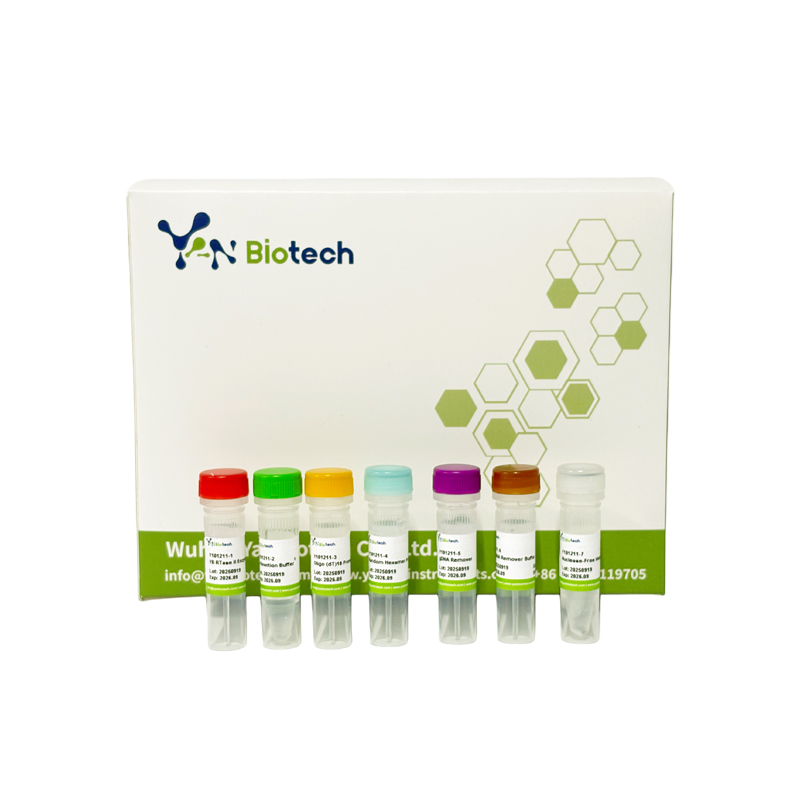
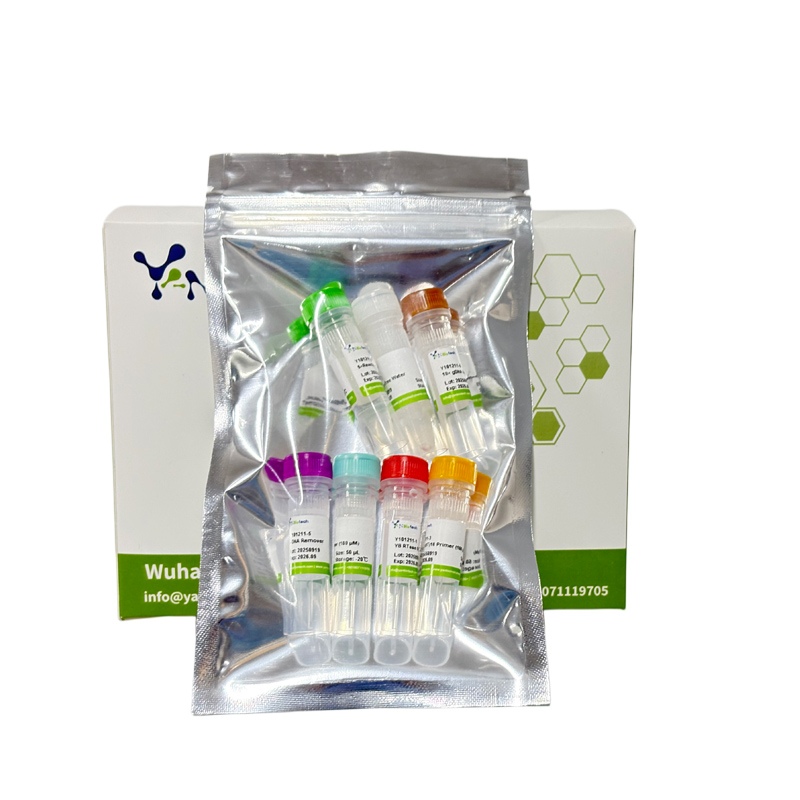
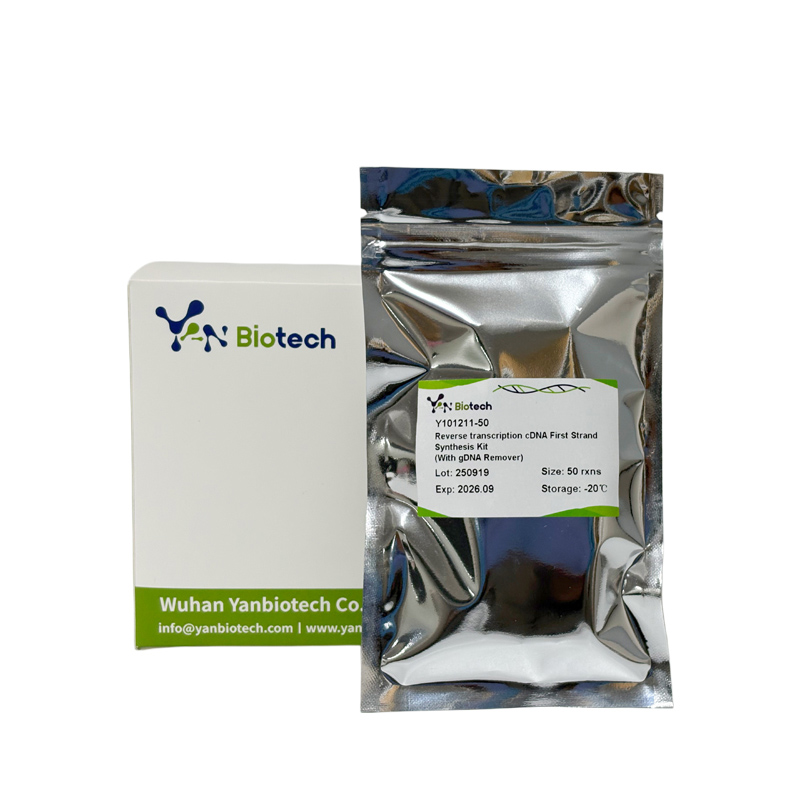
cDNA synthesis within 42–65°C, <10 kb, reverse transcription in 5–15 min, with gDNA removal, suitable for PCR, RT-qPCR, cDNA library construction, hybridization, and antisense RNA synthesis
Cat. No. :
Y101211-50Brand :
YanbiotechProduct Origin :
ChinaVolume :
50rxnsProduct Introduction
This kit utilizes a modified mutant reverse transcriptase to efficiently synthesize first-strand cDNA from total RNA or mRNA templates. It contains all the necessary reagents for high-quality first-strand cDNA synthesis and provides two types of cDNA synthesis primers for selection: Random Hexamer Primer and Oligo(dT)18 Primer. The synthesized single-stranded cDNA product can be directly used in subsequent PCR or qPCR reactions.
Y101211-50 is a mutant reverse transcriptase based on M-MLV Reverse Transcriptase, obtained through in vitro evolutionary screening. YB RTase II lacks RNase H activity, preventing the degradation of RNA within DNA/RNA hybrid templates during first-strand cDNA synthesis, thus ensuring the yield and length of the synthesized first-strand cDNA. Compared to the wild-type enzyme and the first-generation YB RTase I, the second-generation YB RTase II exhibits further improved thermostability and cDNA synthesis efficiency. It can efficiently synthesize cDNA within the range of 42-65°C and complete the reverse transcription reaction in as fast as 5 minutes, making it particularly suitable for reverse transcription of RNAs with complex structures.
This kit also provides gDNA Remover reagent, which can rapidly remove residual genomic DNA contamination from the RNA template before the reverse transcription step. This enhances the reliability of experimental results and simplifies qPCR primer design, eliminating the need for exon-spanning primers.
Storage
Shipping: Wet ice.
Storage: Store at -20°C. Valid for 12 months.
Operation Step
1. Genomic DNA Removal
(1) Thaw the RNA template and Nuclease-Free Water on ice and set aside.
(2) Genomic DNA removal reaction (a 10 μL reaction system is recommended):
| Component | Volume |
| 10×gDNA Remover Buffer | 1 μL |
| gDNA Remover | 1 μL |
| Total RNA/mRNA | 0.1 ng-5 μg / 10 pg-0.5 μg |
| Nuclease-Free Water | Add to 10 μL |
(3) Mix gently and centrifuge briefly.
(4) Incubate at 37°C for 2 minutes, then place on ice for the next step.
2. First-Strand cDNA Synthesis
(1) Prepare the reverse transcription reaction system (a 20 μL reaction system is recommended):
| Component | Volume |
| Genome removal reaction solution in previous step | 10 μL |
| 5×Reaction Buffer | 4 μL |
| Oligo (dT)18 Primer (100 μM) | 1 μL |
| or Random Hexamer Primer (100 μM) | 1 μL |
| or Gene Specific Primer (2 μM) | or 1 μL |
| YB RTase II Enzyme Mix | 1 μL |
| Nuclease Free Water | Add to 20 μL |
Note: For high GC content or complex templates, pre-mix the RNA template, reverse transcription primer, and Nuclease-Free Water. Incubate at 65°C for 5 minutes, then immediately cool on ice. After this, add the other reaction components.
(2) Mix gently and centrifuge briefly.
(3) Reverse transcription program settings:
| Temperature | Time |
| 25℃a | 5 min |
| 55℃b | 5-15 min |
| 85℃ | 5 s |
a: If using the Random Hexamer Primer, incubate at 25°C for 5 minutes before proceeding to the subsequent reaction. If using Oligo (dT)18 Primer or Gene Specific Primer, proceed directly to the 55°C reaction.
b: For high GC content or complex templates, the reverse transcription temperature can be increased to 65°C.
Notice
1. Wear disposable gloves during operation to avoid RNase contamination.
2. Reverse transcription products can be stored short-term at -20°C. For long-term storage, aliquot and store at -80°C, avoiding repeated freeze-thaw cycles.
1. If the template is of eukaryotic origin, it is recommended to use Oligo (dT)18 Primer, which pairs with the 3' Poly A tail of eukaryotic mRNA, to obtain the highest yield of full-length cDNA.
2. For reverse transcription of prokaryotic RNA, please use Random Hexamer Primer or Gene Specific Primer.
3. Random Hexamer Primer has broad applicability and is suitable for templates such as mRNA, rRNA, tRNA, small RNA, and LncRNA.
4. If reverse transcription is followed by qPCR, mixing Oligo (dT)18 Primer with Random Hexamer Primer can achieve uniform cDNA synthesis efficiency across all regions of the mRNA, helping to improve the authenticity and reproducibility of quantitative results.
5. If subsequent qPCR primers are designed to span exons, the genomic DNA removal step can be omitted.
For Research Use Only!




Stay Connected With Us



Copyright @ Wuhan Yanbiotech Co., Ltd. All Rights Reserved.
 Network Supported Xml / Privacy Policy
 English
 English
 Русский
 Español